Tuscany by Rental Car vs. Train: A Practical Comparison for Independent Travelers
Tuscany has a way of making a plan look simple on paper. Florence to Siena, Siena to Pisa, three or four hill towns in between — a clean line on a map, two competing ways to travel it, and a decision that quietly shapes your budget, your timetable and how often you get to stop the car on a ridge to look at the light.
The honest answer is that neither mode wins outright. Trains win in some corners of the region and on some days of the week; cars win in others. What follows is a practical comparison, the kind of detail that only matters once you are standing at a ticket machine with a suitcase and a half-formed plan.
Where the Train Wins Without Much Argument
The Florence–Pisa–Lucca corridor is train country, full stop. Regional services run frequently, need no reservation, and drop you within a short walk of everything you came to see. Pisa's station is roughly twenty minutes on foot from the Leaning Tower; Lucca's sits directly beneath the walls, so you can step off the platform and be on the ramparts in minutes. Florence's Santa Maria Novella is about as central as a station gets anywhere in Europe.
Siena is also a train town, with a caveat worth knowing. The line from Florence runs via Empoli and takes somewhere around an hour and a half. The station, however, sits a couple of kilometres below the walls — there are escalators and frequent city buses up to the centre, so it works fine, but it is not a doorstep arrival. Arezzo and Cortona are straightforward by rail too.
What you gain is simple: no parking to hunt for, no restricted-zone risk, no designated driver, and a fare that is fixed and published before you commit. On a two- or three-city trip, the train is usually the calmer choice.
Where the Car Earns Its Keep
Now drive twenty minutes off any of those railway lines. The Val d'Orcia — Pienza, Montalcino, San Quirico, Montepulciano — is a patchwork of small roads and farm tracks where a bus timetable might offer two useful departures a day, and fewer on Sundays. Chianti is the same story: Greve, Castellina, Radda, and dozens of wineries down gravel lanes that no public transport will ever serve. Volterra, Bolgheri and the villages around San Gimignano all reward a vehicle.
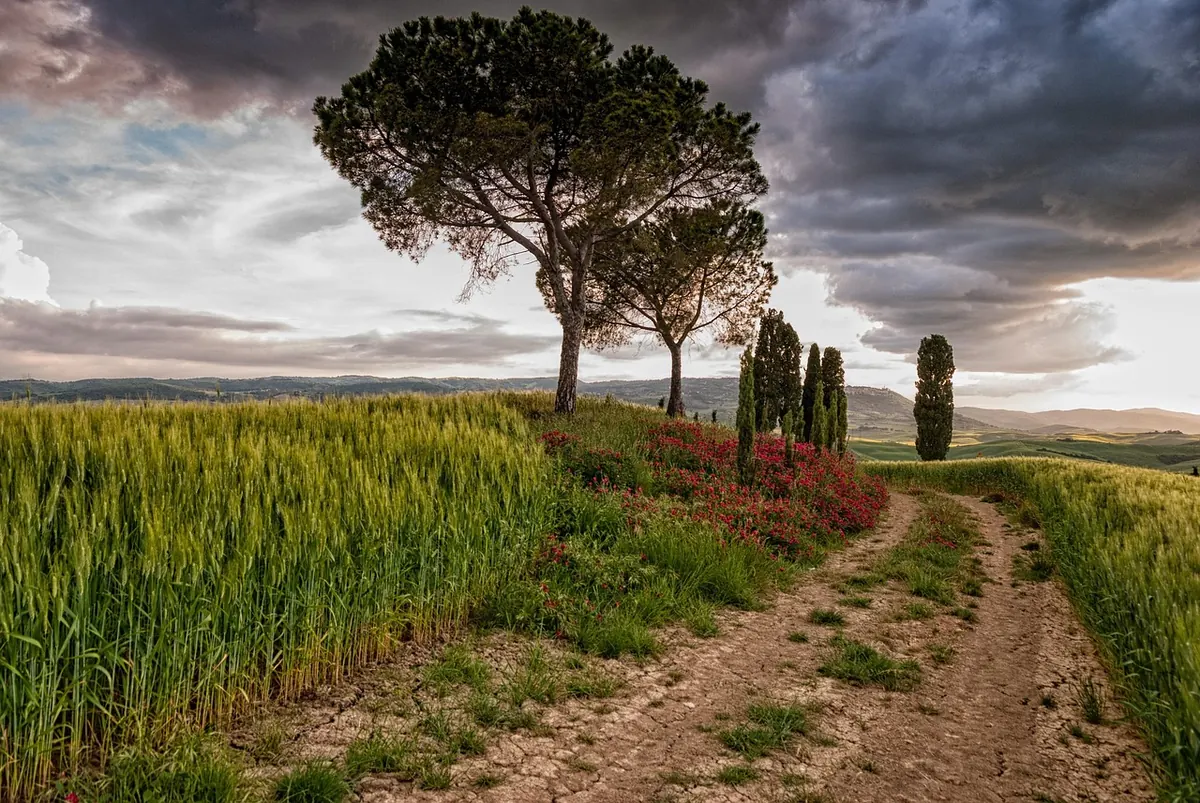
Half the pleasure of Tuscany is the accidental stop — a roadside stall selling pecorino, a cypress-lined lane that turns out to lead somewhere better than your destination. That freedom is the car's real argument, and it is worth paying for if countryside is the point of your trip rather than a backdrop.
Cost: Compare the All-In Number, Not the Sticker
Rental quotes look harmless until you add everything up. Build the true figure before deciding:
- Base rental, plus automatic transmission, an additional driver, and any under-25 surcharge
- One-way drop-off, which can be substantial between different cities
- Fuel — diesel (gasolio) is common; check the filler cap before you leave the lot
- Autostrada tolls on the A1 and A11
- Parking, often a few euros a day in towns and considerably more in Florence
- A contingency for fines, which arrive months later with an agency admin fee attached
Train fares are published per route and don't surprise you. Regional tickets are modest; high-speed services cost more but save real time on longer hops. The arithmetic usually breaks this way: for a couple moving city to city, the train is cheaper and easier. For three or four people sharing a week in the countryside, the car often comes out ahead once parking is split. Do the sums for your actual group size rather than trusting a rule of thumb.
Parking, ZTLs and the Fines That Arrive in Spring
Every Tuscan town of any size has a zona a traffico limitato — a restricted zone enforced by cameras, not by a man in a booth. Drive past the wrong sign and the penalty follows you home, typically through the rental company, which charges an administration fee on top. This is the single most common way independent travelers lose money in Italy.
The colour code on the asphalt matters too: blue lines mean paid parking via a meter or app, white means free, yellow is reserved for residents and permit holders. Larger towns run parcheggi scambiatori on the edge, where you park cheaply and ride a shuttle or escalator in.
- Park outside the walls and walk in — the last five minutes of driving are never worth it
- Photograph your pay-and-display ticket; it's your proof if a fine appears in error
- Read signs twice and look for the ZTL symbol and camera icons before committing to a street
- In Florence, skip the centre entirely: use the Villa Costanza tram terminus or the peripheral car parks
- Refuel before returning the car and keep the receipt
Flexibility, Timetables and the Sunday Problem
Regional trains don't require reservations, which is liberating until you realise the last useful departure on a secondary line can be early in the evening. The Siena–Grosseto and Empoli–Siena routes are scenic and slow; plan the day around the timetable rather than assuming you can drift back whenever you like. Sunday and public-holiday schedules thin out noticeably. If you buy a paper ticket, validate it in the machine on the platform before boarding — this is still expected in the region.
A car gives you the opposite trade: leave when you want, stop when you want, but the driver sobers up for the evening and can't nap on the way home. Add hairpin bends, unlit country roads after dark, and the fact that a GPS will happily aim you at a pedestrian lane in an old town. Navigation apps are useful, and also confidently wrong.
Three Itineraries, Two Modes
Three days, no car
Base yourself in Florence, take an early train to Pisa, see the square, then continue on the same line to Lucca for the afternoon and return in the evening. Day two is Siena by rail, with the escalator up to the centre. It is a compact, low-stress introduction that leaves the countryside for a return visit.
A week, with a car
Collect the car at Florence airport rather than in the city, drive south into Chianti for two nights, then Siena for one, then the Val d'Orcia for three, using Montalcino or Montepulciano as a base. Drop the car at Chiusi or Orvieto and finish by train. The rule: pick up and drop off at the edges, never in the middle.
The hybrid
Train between the big stops, then rent a car for a two- or three-day countryside loop from Siena or Arezzo. You keep the easy city days and still get the lanes, the wineries and the sunset viewpoints — without paying for a vehicle while it sits parked outside your hotel.
Before You Book
Decide what the trip is actually for. If it is art, architecture and cities, take the train and spend the savings on a better room. If it is landscapes and small villages, take the car and accept the parking hunt as part of the deal. Check whether your hotel sits inside a restricted zone before you drive to it, book popular museum slots in advance, and confirm the last train or the last car-park closing time for the days you are relying on either.
And carry a little patience for the small frictions — a ticket machine that only takes coins, a road that narrows without warning. Tuscany is generous with its rewards and mildly stubborn about how you collect them.
Photo: 18623647 / Pixabay